
Cabinet doors that sag and drawers that stick
Most sagging doors just need their hinge screws tightened or adjusted. Stripped screw holes can be filled and redrilled. Drawers that stick or drop usually have worn or broken slides, which can often be replaced without replacing the cabinet. Measure before ordering.

Kitchens in Rosemead homes have often been updated over the years, so you may have anything from original site-built cabinets to newer boxes with European hinges. Either way, doors and drawers take daily abuse.
Sagging doors
Look at the hinges. Concealed hinges (the cup type inside the door) have adjustment screws.
- One screw moves the door left and right.
- One moves it in and out.
- On many hinges, a third moves it up and down.
Surface hinges on older cabinets do not adjust. If the door sags, the screws are usually loose or stripped.

Loose drawer fronts and pulls
Drawer fronts loosen at their screws. Pulls loosen too, and tightening them from inside often fixes the wobble. If a pull hole is stripped, a longer screw or new hardware solves it.
Types of hinges
Newer and updated kitchens often use European concealed hinges, which mount in a round cup bored into the door. Surface hinges are simpler but less adjustable.
Adjusting concealed hinges
Our steps:
- Open the door and find the screws on the hinge arm
- Turn the side screw to move the door left or right
- Turn the depth screw to move the door in or out
- Loosen the mounting plate screws to move the door up or down
- Adjust in small steps and check gaps after each change
Even gaps between doors look best; about an eighth of an inch is typical.
Stripped screw holes
Screws pull out of particleboard and old wood over time. Pack the hole with glued wooden matchsticks or a short length of dowel, give the glue time to set, cut it off level with the surface and drill a fresh pilot hole. For particleboard, special repair inserts or larger screws work better. Moving the hinge a little to fresh material is another option.
Soft-close upgrades
Soft-close hinges and add-on dampers stop doors from slamming. Many concealed hinge brands offer soft-close versions that fit the same cup holes. Add-on dampers can attach inside the cabinet near existing hinges.
Drawer slides
Old drawers often ride on wood runners or plastic rollers that wear out. Full-extension ball-bearing slides let the drawer come all the way out and handle heavier loads. Undermount slides are hidden and often soft-close.

Replacement slides must match the drawer's width clearance, usually half an inch on each side for side-mount slides. Measure the drawer box and cabinet opening before buying.
Older wood-on-wood drawers that stick often just need their runners rubbed with paraffin wax.
Loose drawer fronts and boxes
Re-glue and clamp loose joints, or add corner blocks. A drawer bottom that sags can be supported with a thin plywood brace or replaced.
Hardware and pulls
New pulls and knobs refresh a kitchen. Measure existing hole spacing; common center-to-center sizes are 3 inches, 96 mm, and 128 mm. Matching existing holes avoids filling.
For other kitchen fixes, see garbage disposal jams and under-sink leaks.
Earthquake latches
Kitchen cabinets can open in an earthquake and spill dishes. Childproof or earthquake latches hold doors closed during shaking. See furniture assembly and anchoring.
Sticking and rubbing doors
Doors that rub each other or the face frame usually need side adjustment. Doors that do not close fully may need the depth screw adjusted, or a hinge spring may have failed. A door that drops on the handle side needs the top hinge moved in or the bottom hinge moved out.
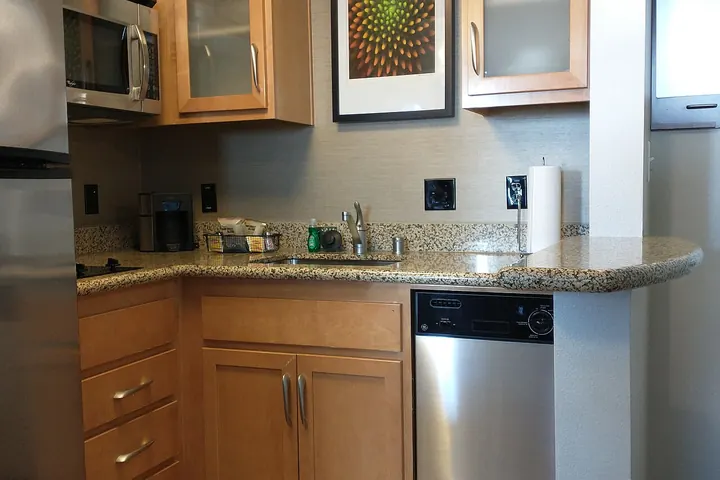

Doors that warp over time can sometimes be pulled flat with an adjustable hinge, but badly warped doors need replacing.
Replacing doors
If doors are damaged beyond repair, new doors can be ordered to match. Painted cabinets are easiest. Measure the opening and the old door, note hinge type and boring, and choose a style that matches. Refacing keeps cabinet boxes and replaces doors and drawer fronts.
Pull-out organizers
Base cabinets with deep shelves are hard to reach into. Pull-out shelves and trash pullouts mount on full-extension slides inside the cabinet. Measure the opening width, depth, and any hinges or face frame that narrows it.
Lubrication
Squeaky hinges respond to a drop of light oil or dry lubricant on the pivot. Wipe off excess so it does not drip on the cabinet. Ball-bearing slides rarely need oil; cleaning out crumbs usually fixes rough movement.
How we fix hinges and slides
We go through every door and drawer, adjust hinges, repair stripped holes, replace broken hinges and slides with matching sizes, and tighten pulls. If you want new hardware, we can install that at the same time. See doors and cabinets.
When you want it done for you, our door and cabinet repair page lists the jobs we take and what to send for a quote. More on the houses themselves: repair notes for postwar Rosemead homes.
Need a hand with this?
Call or text (310) 628-9399, Mon–Sat 8:30 AM–7 PM. A photo is usually enough for a free estimate.
Call or text for a free estimate