
Hard water scale on faucets, aerators and shower heads
Soak aerators and shower heads in vinegar to clear hard-water scale. Drips, stiff handles and leaks at the connections usually mean a worn cartridge or seals, which we replace. Wipe fixtures dry after use to slow new buildup, and skip harsh acid cleaners on finished metal.

Run your finger around the tip of a kitchen faucet in a lot of San Gabriel Valley homes and you will feel a chalky ring. That is mineral scale, mostly calcium and magnesium carbonate left behind as hard water evaporates.
Much of the valley's water comes from groundwater, which tends to carry more dissolved minerals than many surface water sources, and the effects show up on faucets, shower heads, toilets and glass.
In Rosemead's postwar ranch houses, scale combines with fixtures that have been replaced many times over the decades, some good quality and some not. This guide covers the signs of hard water damage, what you can clean yourself, and what we repair.
Signs hard water is affecting your fixtures
- Water sprays sideways or sputters from the faucet
- Flow from a faucet or shower head is weaker than it used to be
- White or tan crust around the faucet base, spout, or handle
- A faucet handle that is stiff or hard to turn
- A drip that starts slowly and gets worse
- Toilet tanks that run, or a bowl ring that will not scrub off
- Spots and film on shower glass
Why it happens
When hard water sits in a fixture and dries, it leaves minerals behind. The aerator screen at the tip of a faucet catches small particles and scale flakes from the pipes. Inside the faucet, scale coats the cartridge or valve, the part that controls flow and temperature.
Rubber seals and O-rings stiffen and wear faster when scale scrapes across them.
Older homes add another factor. When galvanized steel supply lines corrode, they can release rust and scale flakes that collect in aerators and shower heads. Many Rosemead houses have had some or all of their supply piping replaced over the years, but that varies house to house.

Clearing buildup yourself
Clean the aerator. Unscrew the tip of the faucet, using a rag around it to protect the finish. Rinse out debris and soak the screen and parts in white vinegar for an hour or so. Scrub gently with an old toothbrush and reinstall. Many sputtering faucets are fixed in five minutes this way.
Descale a shower head. Remove it, or tie a plastic bag of vinegar around it, and soak for a few hours. Brush the nozzles and rinse well.
Clean scale from surfaces. A vinegar-soaked cloth laid over crusty spots for a while softens buildup. Avoid abrasive pads on chrome and brushed finishes, which scratch.
Check the toilet. If the tank runs, lift the lid and look for scale on the flapper and fill valve. Cleaning helps sometimes, but these parts are inexpensive and often worth replacing.
When buildup means replacing parts
- A faucet that drips from the spout even after cleaning
- Handles that are stiff, loose or leak around the base
- Leaks under the sink at the faucet connections
- A shower head or arm that is seized and will not come off without force
- A toilet that keeps running after new parts
- Several fixtures in the house that need attention
How we deal with crusted fixtures
When a faucet drips, the water gets turned off first; then we open the faucet up and replace the worn part, typically the cartridge, stem, or seals, with the correct replacement for your brand and model. Scale-encrusted parts often need patience to remove without damaging the faucet body.
When a faucet is too worn or parts are not available, we replace it with a new one that fits your sink holes and countertop. We install new supply lines and check the shutoff valves under the sink. Stuck or leaking shutoffs are a common find in older homes, and replacing them makes future repairs easier.
For showers, we remove and replace shower heads and arms, using thread sealant so the new connection does not leak behind the wall. For toilets, we replace fill valves, flappers and seals. Our minor plumbing repairs page has the full list.

Slowing scale down
- Clean aerators and shower heads every few months
- Wipe faucets dry after heavy use in the kitchen
- Use a squeegee on shower glass after each shower
- Pick faucets with ceramic disc cartridges, which tend to hold up well
- Consider a whole-house water softener or filter if scale is severe
What scale tells you about your pipes
If you clean an aerator and find rusty grit rather than white flakes, or if water from one fixture runs brown after the house sits unused, that points to corroding steel pipe somewhere in the system. That is a bigger plumbing repair with its own free estimate. For everything at the fixture, from the shutoff valve outward, we are happy to help.
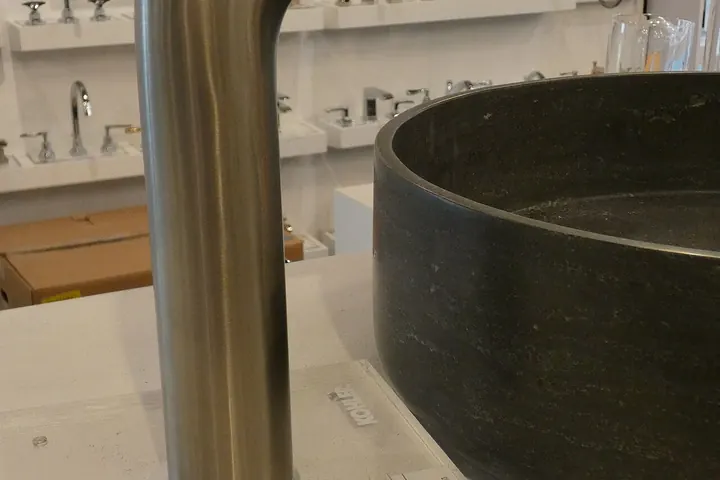

Fixtures worth choosing in a hard-water area
When it is time to replace a faucet, a few features make a difference in hard water. Removable aerators are easier to clean than the hidden kind built into some designs. Shower heads with flexible rubber nozzles let you rub scale away with a thumb.
And simple single-handle kitchen faucets with widely available cartridges are easier to service years from now than unusual designs with proprietary parts.
Cabinets under the sink
Scale and drips often go together, and slow drips under a sink soften the bottom of a sink base cabinet. If the cabinet floor is swollen or stained, we can repair or replace the panel after the leak is fixed. See door and cabinet repair.
Text a photo of the faucet and the space under the sink to (310) 628-9399, and include the brand if you can see it.
When you want it done for you, our plumbing repairs page lists the jobs we take and what to send for a quote. More on the houses themselves: repair notes for postwar Rosemead homes.
Need a hand with this?
Call or text (310) 628-9399, Mon–Sat 8:30 AM–7 PM. A photo is usually enough for a free estimate.
Call or text for a free estimate