
Adding a ceiling fan to a ranch house bedroom
Most 1950s ranch bedrooms have 8-foot ceilings and a light-only ceiling box. A flush-mount fan on a fan-rated box keeps head clearance and runs quiet. The attic above usually makes the box upgrade straightforward. Check the label on the box before you buy the fan.

Rosemead's postwar ranch homes are single story, with low-pitched roofs and attics that heat up in summer. A ceiling fan in each bedroom makes a real difference on warm nights.
Low ceilings need low-profile fans
Most ranch bedrooms have ceilings around 8 feet. A fan on a downrod can hang too low for comfort and safety. A flush-mount or "hugger" fan sits tight to the ceiling and keeps the blades well above head height.
The box matters
Original ceiling boxes in these homes were built for lights. A fan needs a fan-rated box fastened to a joist or a brace. The good news is that ranch homes usually have attic access, so we can often reach the box from above and fasten a proper brace without opening the ceiling.

A ceiling fan weighs more than a light and vibrates while running. Many older Rosemead ceilings have light-only boxes, often shallow metal or plastic boxes held by a single nail.
If yours is not rated, a fan brace bar slides in through the hole and expands between joists, giving a solid anchor without opening the ceiling. Where the attic is accessible, the box can be mounted directly to blocking.
Picking a fan
Choose blade span to suit the room; ENERGY STAR suggests 36 to 42 inches for rooms of 76 to 144 square feet and 44 inches up to 225, which covers most bedrooms. Look for a quiet DC motor if you plan to run it all night, and a warm-white light kit if it replaces the room's main light.

Sizing a fan
ENERGY STAR's sizing chart puts 44-inch fans in rooms of 144 to 225 square feet and 50- to 54-inch fans in rooms of 225 to 400 square feet, so a 52-inch fan suits a room of about 15 by 15 feet or more.
Check airflow ratings in CFM and efficiency in CFM per watt. DC motor fans use less power, run quieter, and often have more speeds.
Switch and controls
If the room has one switch for the old light, a fan with a remote can control both light and fan. If you want separate wall controls, adding a wire between the switch and the ceiling may be possible through the attic. Fan speed controls and light dimmers must be rated for fans.
Balance and noise
A wobbling fan usually has a loose blade, a bent blade holder, or an uneven ceiling mount. Tighten every screw, then use the balancing kit that comes with most fans. A clicking sound often means a loose canopy or light glass. Humming may be a dimmer not made for fans.
Our steps:
- Kill the power and take the old light down
- Confirm the box is fan-rated, or put one in
- Fix the bracket to the box and hang the motor
- Wire the fan, including the ground
- Attach blades, light kit and canopy
- Balance and test every speed
Summer use
Fans make a room feel several degrees cooler by moving air across your skin. Run fans counterclockwise in summer, looking up, to push air down. In winter, reverse slowly to pull air up.
Turn fans off in empty rooms; they cool people, not rooms. Our summer heat checklist has more ideas.
Light kits
Many fans come with a light kit, or offer one as an option. In a bedroom where the fan replaces the only ceiling light, a light kit keeps the room lit. Choose an LED light kit with a warm color temperature.
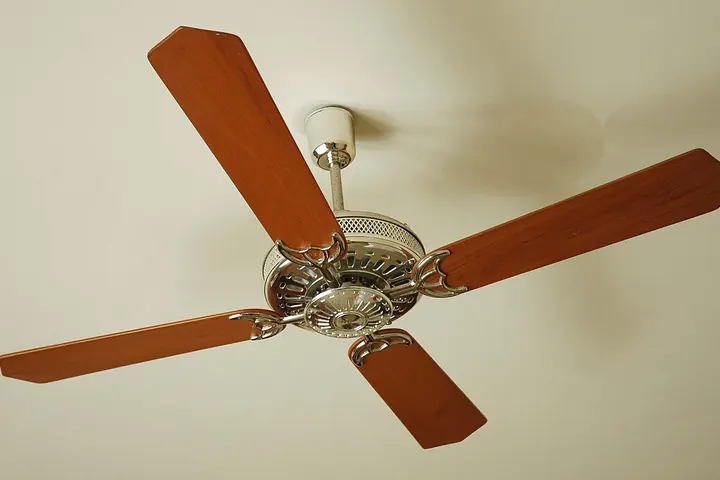

If you want a brighter room, add lamps or a separate fixture.
Outdoor fans
Covered patios benefit from fans too. Outdoor fans must be rated for damp or wet locations, with motors and blades that resist moisture. Patios get hot in summer afternoons, and a fan helps a lot.
Smart controls
Smart fans and wall controls let you set schedules or use voice control. Pick a control that is listed for fans and works with your fan's motor type. DC fans often use their own remotes.
Cleaning
Dust builds up on blades and throws them off balance. Slide an old pillowcase over each blade and pull it back to catch the dust without scattering it.
How a fan goes up
We turn off the breaker, confirm the circuit is dead, remove the old fixture and check the box. We install a fan-rated box or brace, assemble and hang the fan, wire it, and balance the blades. We test every speed and the light. See small electrical.
When you want it done for you, our electrical repairs page lists the jobs we take and what to send for a quote. More on the houses themselves: repair notes for postwar Rosemead homes.
Need a hand with this?
Call or text (310) 628-9399, Mon–Sat 8:30 AM–7 PM. A photo is usually enough for a free estimate.
Call or text for a free estimate